
Reproductive Ability of Currant–Gooseberry Hybrids After Cryopreservation of Pollen in Liquid Nitrogen
Abstract
The present study of the reproductive ability of currant and gooseberry hybrids after long-term cryopreservation of pollen in liquid nitrogen is of enormous importance for organizing the conservation of the diversity of this crop. Four distant interspecific hybrids of currant and gooseberry served as objects of the study. The pollen fertilizing ability was studied by pollination of allotetraploid Jošta with pollen of tetraploid hybrids stored for a year at ultra-low temperatures (–196°C) and freshly collected pollen (control pollination). Berry set in 2022, when pollinated with cryopreserved pollen, averaged 56.4% and was higher than in the control pollination (38.2%). In 2023, the number of berries set on average for all cross combinations in the experiment was also quite high (59.6%), but lower than in the pollination control (81.4%), which can be explained by unfavorable weather conditions during pollen collection in the year of establishment (2022). The obtained data specify that pollen of the allotetraploids does not lose its high fertilizing ability during its long-term cryopreservation. Berry setting, average berry weight and seed production are quite high and comparable to pollination with freshly collected pollen (control pollination variant). Seed germination and values of morphometric parameters of seedlings obtained from pollination with cryopreserved and freshly collected pollen in most cases have close values. Cryopreservation of pollen of currant-gooseberry hybrids for a year and more allows preserving pollen for successful pollination and berry formation and is a reliable way to preserve germplasm.
Article Information
- Received
- Accepted
- Published
Copyright © 2025 O. A. Tikhonova, et al.
 This is an open-access article distributed under the terms of the Creative Commons Attribution License, which permits unrestricted use, distribution, and reproduction in any medium, provided the original author and source are credited.
Corresponding author: V.G. Verzhuk, N.I. Vavilov All-Russian Institute of Plant Genetic Resources, 42, 44 Bolshaya Morskaya Street, St. Petersburg 190000, Russia —
Competing Interests
The authors have declared that no competing interests exist.
Funding
No specific funding statement was provided by the authors.
Data Availability
No data-availability statement was provided by the authors.
Citation:
Introduction
The storage of plant resources in the form of pollen is one of the most important ways to preserve plant diversity because pollen contains all the information about the haploid genome of a species 1, 2. Due to its extremely small size, compactness and ease of storage, more genotypes are conserved compared to other forms of plant objects 3. Long-term pollen storage can effectively overcome ecological and geographical obstacles when crossing parental forms that flower at different times and geographical locations 1. Presently, pollen cryopreservation covers a wide range of crops including cereals, fruits, vegetables, ornamental, medicinal plants, herbs, and other plant objects 1; and studies are performed to on the individual characteristics of the preserved samples. A lot of data on the problem of long-term cryopreservation of pollen of fruit crops has been accumulated. Thus, in the work of D. Parfitt and A. Almehdi (1983) showed the possibility of storing pollen of 21 grape varieties at ultra-low temperatures. The scientists found that rapid freezing of pollen and storing it for an hour in liquid nitrogen (–196 °C) did not reduce its viability. The differences in the number of germinated pollen grains between frozen and freshly collected pollen were less than 5%. There were also no differences in the appearance of pollen grains and pollen tube growth dynamics 4.
In the 1980s, these researchers continued their work on the cryopreservation of pollen of almond, apricot, peach, plum and cherry. They found that after immersing pollen of these fruit crops in liquid nitrogen for one hour and thawing it at room temperature, there is no significant loss of its viability 4. Alike results were obtained by the same scientists in a study of pollen viability of 10 olive cultivars. The loss of viability averaged only 2.8% for all the varieties studied. No peculiarities in the length or morphology of pollen tubes were observed in both experiments. There were significant differences in pollen viability between the different genotypes, and even the pollen with the lowest viability was still quite suitable for successful pollination 4.
At the Institute of Horticulture in Bangalore, India, studies by S. Ganeshan found that after 64 weeks of storage of pollen from five grape varieties in liquid nitrogen (–196°C), an increase in viability of 3.1–7.7% was observed compared to the control (freshly collected pollen) 5. After 4 years of cryopreservation pollen of 19 Prunus mume cultivars was used successfully for intraspecific hybridizations at Wuhan and Beijing in 2005 and 2006 6.
Similar results were obtained when cryopreserving pollen of other fruit crops: cherry, cherry and plum 7. In black currant, the increase in pollen viability after cryopreservation was observed in a significantly larger number of varieties compared to the above-mentioned crops 8. Currently, cryobanks in many countries, Japan 9, USA 10, 11, Canada (Mercier, 1995), Russia 12, 13, China 1 store pollen from various plants, however, in most cases according to Ren et al. 1 studies on its viability after cryopreservation at ultra-low temperatures cover a short storage time period, ranging from a few days to a few months.
There are very little data on the reproductive capacity of pollen after long-term cryopreservation. It's known that successful pollen cryopreservation was achieved in six species of Psidium with varying germination profiles in vitro, fruit and seed set when attempted pollination 14. Also, when determining the fertilizing ability of black currant pollen after storing it for a year at ultra-low temperatures (–196°C), it was found that berry set and average berry weight were high and comparable to the control pollination variant, and in some cases exceeded it 15. The literature also lacks information on long-term storage of pollen of currant-gooseberry hybrids and its reproductive capacity after long-term cryopreservation.
It should be noted that currant-gooseberry hybrids are tetraploids (n=32) obtained from crossing currant and gooseberry.
Crossing gooseberries with black currant and combining their valuable properties in one plant is a long-standing dream of breeders 16. It was realized when the sterility of distant hybrids was overcome with the help of experimental polyploidy
methods. The first obtained interbreeding currant-gooseberry hybrids, having traits of intermediate character, turned out to be sterile or set a small number of fruits, seeds which were almost always absent 17. Breeders, when carrying out distant crosses, tried to solve private problems of one of the crops: obtaining a bearingless gooseberry or creating black currant varieties resistant to the bud mite by introducing into the currant genome the Ce gene from gooseberry, which provides high resistance to this pest. In addition, it seemed that in such hybrids it would be possible to combine the best qualities of both crops: meaninglessness and high vitamin content of currants, large fruitfulness of gooseberries, high flavor qualities of both parental forms, resistance to diseases and pests, especially to bud mite, upright bush habitus. The problem of obtaining fertile interbreeding hybrids was successfully solved by methods of experimental polyploidy.
In the 50s of the XX century in England, at the East Malling station R. Knight, E. Kip and J. Parker using all available methods of selection (distant hybridization, polyploidy, backcross, selection on an infectious background) managed to transfer the Ce gene controlling resistance to kidney mite from gooseberry to currant 18. Hybrids B 1323/3 and 3231 included in the study are the result of the work of the staff of this station.
In the 70s of the last century, as a result of forty years of work at the Max Planck Institute (Germany), R. Bauer obtained the first fruit-bearing currant-gooseberry hybrid, named Jošta, from the merger of the first letters of the German letters. The first fruit-bearing currant-gooseberry hybrid, named Jošta, was obtained by R. Bauer at the Max Planck Institute (Germany) as a result of the merger of the first letters of the German name of currant (Johannisbeere) and gooseberry (Stachelbeere).
In Sweden, at the agricultural station in Alnarpe, interspecific crosses in the forties of the last century were conducted by Prof. F. Nilsson, which resulted in a fertile currant-gooseberry hybrid Kroma only in 1979 19.
At present, hybrids Jošta and Kroma have acquired the status of varieties and are successfully cultivated in the countries of Western Europe.
When studying the pollen morphology of currant-gooseberry hybrids, no increase in pollen size was detected compared to currant and gooseberry, but the presence of small-sized pollen grains was noted. All transitional forms of pollen aperture types from meridional-furrow (in gooseberries) to global-pore (in currants) are found in them 20.
The reproductive ability of pollen of currant-gooseberry hybrids after its long-term cryopreservation at ultra-low temperatures (–196оС). In this connection, the aim of our work was to reveal the real fertilizing ability of pollen of currant and gooseberry hybrids after 12 months of storage in liquid nitrogen at –196оС.
Material and Methods
The objects of our study were the varieties Jošta and Kroma, as well as interbreeding hybrids of currant and gooseberry (E. Kip) – B 1323 /3 and 3231, which were received in the collection of the Pavlovsk Experimental Station of VIR from A. S. Ravkin (FSC Horticulture, Moscow). The initial forms for obtaining the variety Jošta were (Ribes nigrum × R. grossularia) × (R. nigrum × R. divaricatum).
The variety Kroma was obtained from crossing hybrid forms (Ribes nigrum × Grossularia) × (Ribes nigrum × R. niveum). The genetic origin of hybrids 3231 and B 1323/3 was not established.
The pollen of currant-gooseberry hybrids was stored in the Laboratory of Long-term Storage of Plant Gene of VIR. Pollen collection of the studied samples was carried out in II–III decades of May. From bushes of one variety, 200–250 well-developed buds were collected in dry weather and anthers were separated in laboratory conditions. Pollen was dried to a loose state at 21°C for two to three days, then it was placed in cryotubes and frozen by direct immersion in liquid nitrogen (–196°C), where it was stored for 12 months.
The pollen fertilizing ability was studied on the black currant collection of ‘Pushkin and Pavlovsk Laboratories of VIR’ in 2022–2023 by crosses. The tetraploid Jošta was used as a pollinated sample; pollination was carried out with pollen from tetraploid varieties Kroma, Jošta and tetraploid currant-gooseberry hybrids B 1323/3 and 3231. In the budding phase, anthers were removed from unopened buds, followed by isolation of branches with castrated buds. After 2–3 days, prepared freshly collected pollen (control) and pollen after 12 months of storage in liquid nitrogen (experiment) were applied to the stigmas of pistils of unopened flowers. A total of 8 crossing combinations were carried out; each of them pollinated at least 50–60 flowers in two pollination variants. When analyzing the obtained data, berry set, berry weight and number of seeds for each pollination variant were taken into account. Meteorological data for the spring months of 2022–2023, in which pollination was conducted, were obtained from the Department of Automated Information Systems (AIS) of Plant Genetic Resources. Statistical processing of the results of the study was performed using the Microsoft Excel program package.
Weather conditions in 2022–2023 during pollination and ovary formation were not favorable enough. Thus, in 2022, immediately after pollination (May 18), a decrease in average air temperature to 9.5°C was observed. The minimum air temperature was 5.6°C (Figure 1).
Figure 1. Minimum and average temperature in May 2022–2023 (St. Petersburg)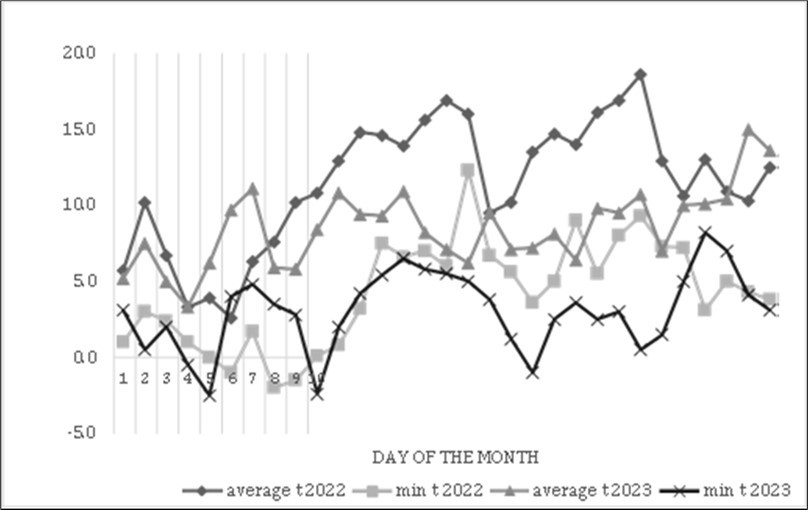
Download figure
In 2023, pollination was also carried out on 12 May at a low average air temperature (9.4°C); the minimum temperature was only 4.2°C. During the period of ovary formation, the minimum air temperature dropped to –1°C (Figure 1).
Results and Discussion
Currant-gooseberry hybrids have large (1.3–1.8 cm in diameter) bell-shaped or rounded-bell-shaped flowers with a wide-open pharynx and a long, slightly bubbly or bubbly-granite peduncle tube.
Studies by G. P. Rainchikova 20 and V. V. Zhdanov 22 show that the duration of the “active life” of currant flower is 7 days on average.
V. Zhdanov 22 showed that the duration of “active life” of a flower in currants is 7 days on average. In gooseberry, according to the observations of G. G. Geints 23, this period is 5–8 days.
The study of the duration of active pollen perception by pistil stigmas in currant-gooseberry hybrids showed that flower opening in tetraploids Jošta and Kroma does not differ from flower opening in the genus Ribes L. described by N. M. Pavlova 16.
The process of fertilization and berry setting in them is most successful in the first three days after flower blossoming. On the 4th day there is a significant decrease in wilting rate. On the 5th day, the wilting rate is 17.1–22.1%. On the 6th day after flowering in Jošta variety and on the 7th day in Kroma variety, pistil stigmas turn black and become incapable of accepting pollen 24.
In 2022, we conducted selection crosses to determine the reproductive ability of pollen of currant and gooseberry hybrids after its cryopreservation for a year.
It was found that berry setting in tetraploids when pollinated with cryopreserved pollen amounted to 46.9–68.6% or an average of 56.4% in all combinations of crosses; in the control variant of pollination the value of berry setting varied depending on the pollinator from 28.6 to 45.6% (an average of 38.2%) (Table 1).
Table 1. Parameters characterizing the fertilizing ability of pollen of currant and gooseberry hybrids after long-term storage at ultra-low temperatures (–196°C); Pushkin and Pavlovsk laboratories of VIR, 2022.| Pollinated variety | Pollination variations: | ||||||
| Pollinator variety | with pollen from cryopreservation (LN) | with freshly picked pollen (C) | |||||
| berry setting, % | Average berry weight, g | Average number of seeds, pcs. | berry setting, % | Average berry weight, g | Average number of seeds, pcs. | ||
| Josta | B 1323/3 | 68,6±1,05 | 1,24±0,02 | 5±0,8 | 45,6±4,4 | 1,21±0,16 | 5±0,36 |
| 3231 | 53,8±11,2 | 1,27±0,11 | 5±0,5 | 40,5±3,0 | 1,28±0,12 | 3±0,69 | |
| Josta | 46,9±5,7 | 1,26±0,02 | 4±0,6 | 28,6 | 0,98±0,07 | 3±0,50 | |
| Average | 56,4 | 1,26 | 5 | 38,2 | 1,16 | 4 | |
Thus, the berry setting rate was 13.3–23.0% higher when pollinated with cryopreserved pollen compared to the control variant pollinated with freshly collected pollen. The cross combinations Jošta × B 1323/3 and Jošta × 3231 (Table 1) were the most effective.
The values of the parameter “average berry weight” were close in value in both pollination variants, and the Jošta × Jošta combination showed an increase in berry weight by 0.28 g when pollinated with pollen after long storage (Table 1).
It was also found that there were no differences in the number of seeds set when pollinated with cryopreserved pollen.
In 2023, the work on studying the fertilizing ability of tetraploid pollen after its long-term cryopreservation in liquid nitrogen at ultra-low temperatures (–196°C) was continued.
As studies have shown, berry setting ability in pollination with cryopreserved pollen amounted to 42.1–76.5% or 59.6% on average for all crossing combinations this year; in pollination with freshly collected pollen (C) – 68.7–94.5% or 81.4% on average. The cross combinations Jošta × Kroma and Jošta × 3231 were the most effective (Table 2, Figure 2 and Figure 3).
Table 2. Parameters characterizing the fertilizing ability of pollen of currant and gooseberry hybrids after long-term storage at ultra-low temperatures (–196°C); Pushkin and Pavlovsk laboratories of VIR, 2023.| Pollinated variety | Pollination variations: | ||||||
| Pollinator variety | with pollen from cryopreservation (LN) | with freshly picked pollen (C) | |||||
| berry setting, % | Average berry weight, g | Average number of seeds, pcs. | berry setting, % | Average berry weight, g | Average number of seeds, pcs. | ||
| Jost a | Kroma | 76,5±10,5 | 1,40±0,08 | 3±0,31 | 68,7±8,2 | 1,57±0,08 | 4±0,3 |
| 3231 | 72,9±2,2 | 1,28±0,08 | 4±0,41 | 73,5±26,5 | 2,28±0,12 | 8±0,9 | |
| B 1323/3 | 47,0±11,1 | – | – | 94,5±0,65 | 2,20±0,09 | 13±0,6 | |
| Josta | 42,1±3,8 | 1,16±0,13 | 2±0,34 | 88,8±11,2 | 1,59±0,07 | 4±0,58 | |
| Average | 59,6 | 1,28 | 3 | 81,4 | 1,91 | 7 | |
Figure 2. Berry setting in Jošta x Kroma cross combination: (a) Pollination with cryopreserved pollen; (b) Pollination with freshly collected pollen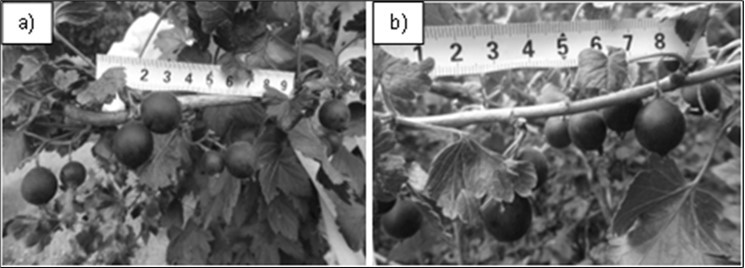
Download figure
Figure 3. Berry set in Jošta x 3231 cross combination: (a) pollination with cryopreserved pollen; (b) pollination with freshly collected pollen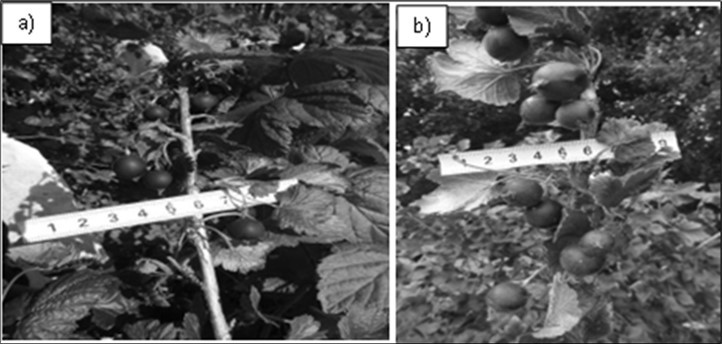
Download figure
In the cross combination (Jošta × Kroma), the results obtained for berry set were higher in the variant pollinated with cryopreserved pollen; in the cross combination Jošta× 3231, the values of berry set obtained in both variants were close in value (Table 2). In the other two cross combinations (Table 2), berry set was higher when pollinated with freshly collected pollen, although enough berries were set even in this case. The possible reason for low berry setting in the experiment variant was unfavorable weather conditions in the year of pollen collection and laying pollen for long-term storage (2022) and individual characteristics of the samples.
The average berry weight in pollination with pollen stored at ultra-low temperatures for a year was 1.16–1.40 g, in the control pollination variant – 1.57–2.28 g, i.e. was on average 0.63 g lower than in pollination with freshly collected pollen (Figure 4). Seed productivity under pollination with cryopreserved pollen in 2023 was lower than that of the control pollination variant (Table 2).
Figure 4. Berries of currant and gooseberry hybrids set by pollination with cryopreserved (LN) and freshly collected pollen (C); Pushkin and Pavlovsk laboratories of VIR, 2023.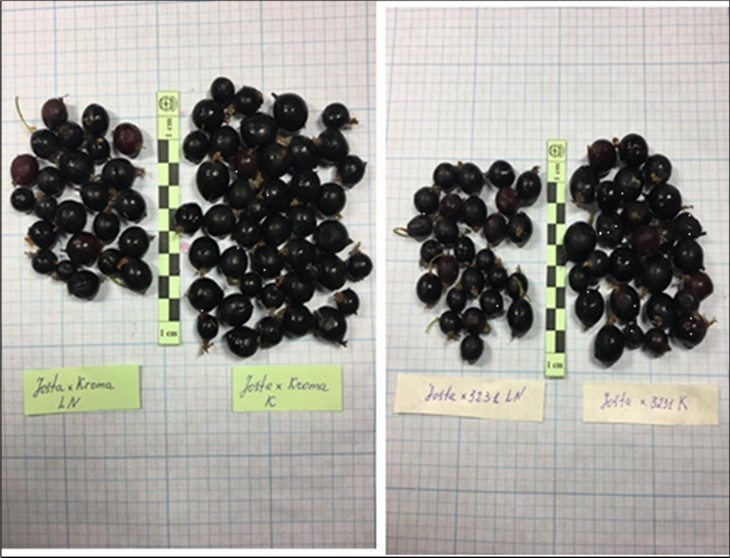
Download figure
Comparison of the results showed that in the cross combination Jošta×Jošta, the number of berries set in the variant pollinated with cryopreserved pollen in 2022 and 2023 had close values. In the combination Jošta×3231, the number of berries set in 2023 was lower by 19.1%, and, on the contrary, when Jošta was pollinated with cryopreserved pollen of tetraploid hybrid B 1323/3 (Jošta×B1323/3), the number of berries formed in 2023 was higher by 21.6% compared to the previous year.
The results obtained in pollination indicate, in our opinion, a rather good pollination with cryopreserved pollen, although in 2023 in a number of cross combinations the berry set was lower than in pollination with freshly collected pollen, but nevertheless quite sufficient to judge the success of pollination with such pollen.
Seeds obtained in 2022 were stratified and then sown in plastic containers in the greenhouse.
The germination characteristics of the hybrid seeds obtained are summarized in Table 3.
Table 3. Germination of seeds of tetraploid hybrids; Pushkin and Pavlovsk laboratories of VIR, 2023.| Crossbreeding combination | Number of seedlings grown from hybrid seeds, % | |
| LN | C | |
| Jošta × Jošta | 20,4 ± 0,4 | 46,7 ± 4,5 |
| Jošta ×3231 | 24,5 ± 2,1 | 26,7 ± 6,7 |
| Jošta × B1323/3 | 13,3 ± 1,9 | 15,5 ± 1,2 |
In two cross combinations (Jošta×3231 and Jošta×B1323/3), the number of seedlings obtained from seeds in both variants was close in value. In the Jošta × Jošta cross combination, the number of seedlings in the control pollination variant was almost twice as high as the number of seedlings from seeds from pollination with cryopreserved pollen.
In June 2023, the length and number of nodes formed were measured in seedlings.
The data obtained are summarized in Table 4.
Table 4. Morphometric parameters of seedlings from crosses 2022; Pushkin and Pavlovsk laboratories of VIR, 2023.| LN | C | |||
| Crossbreeding combination | Length seedlings, cm | Number of nodes, pcs. | Length seedlings, cm | Number of nodes, pcs. |
| Jošta × Jošta | 12,6±2,6 | 6±1,1 | 7,8±1,5 | 5±0,4 |
| Jošta ×3231 | 9,5±0,9 | 7±0,7 | 6,3±1,1 | 4±0,4 |
| Jošta × В1323/3 | 12,0±2,5 | 6±1,0 | 12,6±1,9 | 6±0,6 |
| Average | 11,4 | 6 | 8,9 | 5 |
As shown (see Table 4), the length of seedlings obtained from pollination with cryopreserved pollen averaged 11.4 cm and ranged from 9.5 to 12.6 cm; in the control pollination variant it averaged 8.9 cm and ranged from 6.3 to 12.6 cm. In two crossing combinations (Jošta×Jošta and Jošta×3231), the length of seedlings obtained from pollination with cryopreserved pollen was longer by 5.9 and 6.1 cm, respectively. In the Jošta×B1323/3 cross combination, the seedlings had approximately the same length in both experiments. The number of formed nodes in both pollination variants had close values on average (Table 4).
Figure 5. Shows the grown hybrid seedlings.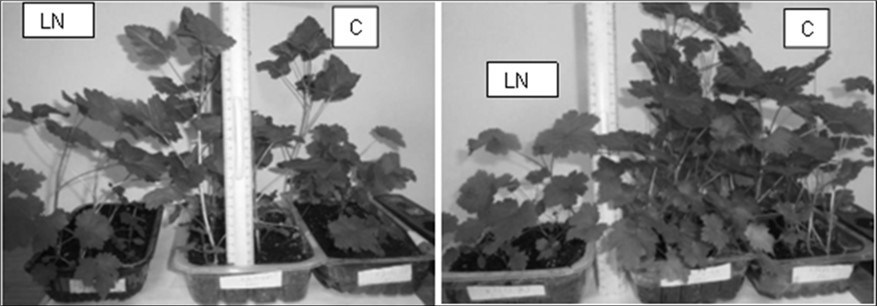
Download figure
Figure 6. Seedlings grown from pollination with cryopreserved pollen (LN) and freshly collected pollen (С); Pushkin and Pavlovsk laboratories of VIR, 2023.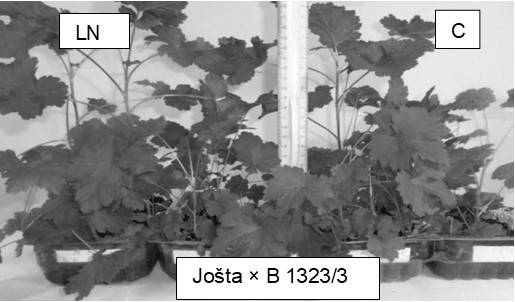
Download figure
In August 2023, the seedlings were planted from the containers into the greenhouse. Before planting the seedlings for pre-growing, their morphometric parameters were evaluated, which included measurement of seedling length, length of its root system and number of internodes on the plant (Table 5, Figure 7).
Table 5. Morphometric parameters of tetraploid seedlings; Pushkin and Pavlovsk laboratories of VIR, 2023.| LN | C | |||||
| Crossbreeding combination | Length seedlings, cm | Number of internode | Root system length, | Length seedlings, cm | Number of internodes, pcs. | Root system length, |
| s,pcs. | cm | cm | ||||
| Jošta × Jošta | 12,1±2,2 | 8±1,1 | 7,6±1,4 | 10,5±3,5 | 7±1,4 | 8,0±3.2 |
| Jošta ×3231 | 12,7± 1,6 | 9±0,9 | 8,7±1,1 | 6,8±2,2 | 5±1,2 | 6,5±2,7 |
| Jošta× В1323/3 | 9,8±0,9 | 5±0,4 | 4,8±0,6 | 9,9±1,8 | 8±0,9 | 5,1±0,7 |
| Average | 11,5 | 7,3 | 7,0 | 9,1 | 6,7 | 6,5 |
Figure 7. Seedlings of tetraploids obtained from pollination with cryopreserved pollen (LN) and freshly collected pollen (C); Pushkin and Pavlovsk laboratories of VIR, 2023.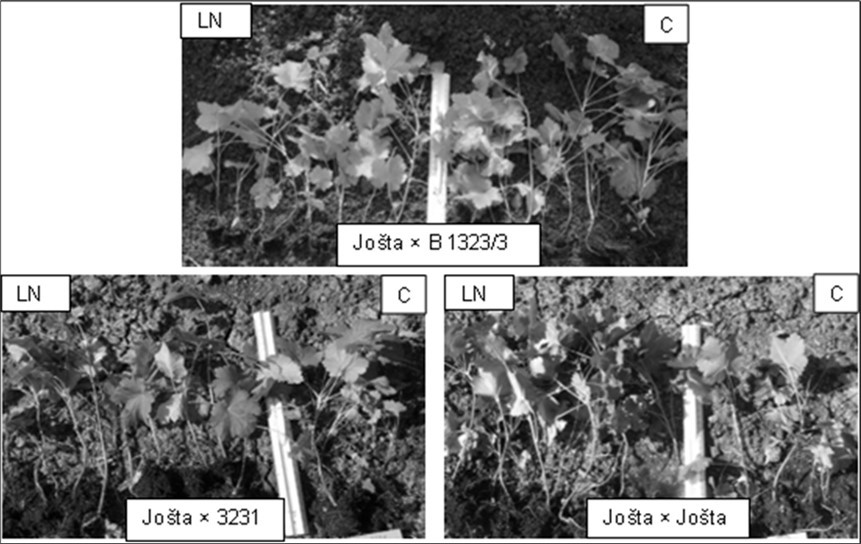
Download figure
As it turned out, in combinations of crosses Jošta × Jošta and Jošta × B1323/3, morphometric parameters of seedlings obtained from seeds from pollination with pollen after long-term storage and the control pollination variant (freshly collected pollen) were quite close in value (Table 5). In the pollination variant Jošta × 3231, the values of all parameters in the seedlings obtained from seeds from pollination with pollen after its long-term storage at ultra-low temperatures exceeded the parameters of the control pollination variant.
Conclusion
The data obtained during pollination of Jošta tetraploid with pollen after cryopreservation (within a year) indicate that pollen of distant currant-gooseberry hybrids does not lose its high fertilizing ability during its long-term cryopreservation.
Berry setting, average berry weight and seed productivity are quite high and comparable with pollination with freshly collected pollen (control pollination variant), and in some cases exceed it.
Seed germination and values of morphometric parameters of seedlings obtained from pollination with cryopreserved and freshly collected pollen in most cases have close values.
Cryopreservation of pollen of currant-gooseberry hybrids for a year allows preserving pollen for successful pollination and berry formation and is a reliable way to preserve germplasm.
The period of pollen viability should be determined by the individual characteristics of the genotype; pollen from varieties that lose a significant percentage of viability during cryopreservation should be regularly renewed to ensure safe and stable storage.
The research was performed within the framework of the State Task according to the theme plan of VIR, Project No. FGEM-2022-0004 “Improving approaches and methods for ex situ conservation of the identified gene pool of vegetatively propagated crops and their wild relatives, development of technologies for their effective use in breeding”.
References
- 1.Ren R, Li Z, Li B, Xu J, Jiang X et al. (2019) Changes of pollen viability of ornamental plants after long-term preservation in a cryopreservation pollen bank. Cryobiology 89, 14-20.
- 2.N B Dinato, Santos I R I, Vigna B B Z, A Ferreira de Paula, A P Favero. (2020) Perspective: Pollen cryopreservation for plant breeding and genetic resources conservation // Cryoletters. 41(3), 115-127.
- 3.Kozaki H, Omura M, Matsuta N, Moriguchi T. (1988) Germplasm Preservation of Fruit Trees. Preservation of Plant Genetic Resources. Japan international cooperation agency. 5, 65-74.
- 4.D E Parfitt. (1983) Almehdi A.A. Cryogenic storage of grape pollen. American Journal of Enology 34-4.
- 6.Ya-Li Zhang, Chen R-D, Huang C-J, Liu Y. (2009) Cryo-banking of Prunus mume pollen and its application in cross-breeding // Cryoletters. May-Jun; 30(3), 165-170.
- 7.Orlova S Yu, A V Pavlov, V G. (2019) Pollen viability of cherry (Cerasus avium Mill.) varieties of different ecological and geographical origin in the conditions of the North- Western region of Russia//. Proc. of Applied Botany, Gen. and Breeding. St. Petersburg. Т. 180. Vyp. 1. С (in Russian) 66-72.
- 8.O A Tikhonova, O A Gavrilova, E A Radchenko, V G, Pavlov A A V. (2020) Viability of black currant pollen before and after cryopreservation in liquid nitrogen and features of its morphology //. Proc. of Applied Botany, Gen. and Breeding (in Russian) 181, 10-30901.
- 9.Akihama T, Omura M. (1986) Preservation of Fruit Tree Pollen. Trees I. , Berlin Heidelberg: Springer 101-112.
- 10.K F Connor, L E Towill. (1993) Pollen handling protocol and hydration/dehydration characteristics of pollen for application to long-term storage. Euphytica 68, 77-84.
- 11.Gupta S, M B Reed. (2006) Cryopreservation of shoot tips of blackberry and raspberry by encapsulation-dehydration and vitrification // Cryoletters. 27(1), 29-42.
- 12.A V Manzhulin, I M Yashina. (1984) Preservation of potato pollen under ultralow temperatures. Agricultural Biology. (in Russian) 4, 56-59.
- 13.V G, G I Filipenko, G F Safina, A V Pavlov, A S Zhestkov. (2012) Cryopreservation – an effective method for the conservation of genetic resources of fruit and berry crops //. Proc. of Applied Botany, Gen. and (in Russian) .
- 14.Vishwakarma P, Vincent L, Vacugi C, P E Rajasekharan. (2021) Effect of cryopreservation on pollen viability, fertility and morphology of different Psidium species. // Cryobiology 98, 112-118.
- 15.O A Tikhonova, Radchenko E, A V Pavlov. (2021) Reproductive ability of black currant varieties after cryopreservation of pollen in liquid nitrogen //. Proc. on Applied Botany, Gen. and Breeding 182, 71-78.
- 17.Berbank L. (1955) Twelve other wonderful berry plants, which are material for breeding and creation of new forms. , Moscow. (in Russian)
- 18.I M Kovtun. (1962) The effectiveness of different methods of creation of thornless gooseberry. Biology and breeding of fruit crops. , Kiev. (in Russian)
- 19.Nilsson F. (1979) Kroma nytt bärslag kommer I handeln in: Kommery handeln Viola Tradgardvariden. 16, 7.
- 20.O A Gavrilova, O A Tikhonova. (2013) Diversity of pollen grain shapes, and their distribution across some Grossulariaceae species and hybrids. , Petrozavodsk. (in Russian)
- 21.G P Rainchikova. (1971) Biology of flowering and pollination of black currant varieties of different origin in conditions of Belarus. Abstract of the thesis. , Minsk. (in Russian)
- 22.V. (1971) Biological features of flowering, pollination and fertilization of black currant varieties and seedlings in connection with their self-fertility. , Orel. (in Russian)
- 24.O A Tikhonova, O A Gavrilova, N A Pupkova. (2015) Morpho-biological features of black currant-gooseberry hybrids in the North-West of Russia // Contemporary horticulture. 4, 42-60.
- 25.I S Chepinoga, M V Erastenkova, A, V G. (2023) Viability assessment of quince cuttings and pear pollen after cryoconservation in liquid nitrogen vapor (-183-185ºC) BIO WEB of conferences 78.
- 26.Nebroy K Yu. (2023) Modern directions in black currant breeding research and possible ways of their implementation // Contemporary horticulture. DOI: 10.52415/231267.1_2023_0102 (in Russian) 1, 15-30.
- 27.D E Parfitt, A. (1984) Liquid nitrogen storage of pollen from five cultivated Prunus species. HortScience 19, 69-70.
- 28.Parfitt D. (1984) Almehdi A.A. Cryogenic storage of olive pollen. Fruit Varieties Journal. 38, 14-16.
- 29.A V Pavlov, V G, D. (2019) The effect of phytohormones and light on the germination of apple pollen with reduced viability. Proceedings on applied botany, genetics 180(4), 27-31.
- 30.A V Pavlov, V G, Orlova S Yu. Cryopreservation as a method to preserve fruit and berry crops and medicinal plants. Problems of Cryobiology and Cryomedicine. 2019; 29(1): 44–57. DOI: 10.15407/cryo29.01.044. (in Russian) .
- 31.M N Sitnikov, V G, A V Pavlov. Study of viability of apple pollen using media with different sucrose content after cryopreservation. Abstracts of the International Scientific Conference ‘Plant Genetic Resources...’. SPb.: R-KOPI (in Russian) 32.