Morphological Attributes and Yield of Momordica charantia (Bitter Gourd) Under the Application of Spiritual Blessing/Biofield Energy Treatment (BET)

Abstract
Objective
Bitter gourd (Momordica charantia L.) is a widely consumed vegetable. This study aimed to assess the impact of spiritual blessing (biofield) energy treatment (S/BET) known as the Trivedi Effect® on a plant’s growth and yield when applied to both seeds and soil.
Methods
Seeds were split into two groups: an untreated control group (CONBIGG) and a BET-group (BTBIGG). Soil texture was checked by hand, and mineral contents were measured using standard procedures. An experienced scholar noted plant morphological, phenological, and yield-related parameters.
Results
The S/BET group showed improvements in stem length, fruit colour, and seediness compared to the control. Other phenological parameters, such as vine length (38.78 %; p ≤ 0.001), branch number (54.03 %; p ≤ 0.01), inter-nodal length (42.94 %; p ≤ 0.001), fruit length (33.27 %; p ≤ 0.001), seed length (40.32 %; p ≤ 0.001), seeds per fruit (52.50 %; p ≤ 0.001), and fruits per vine (66.88 %; p ≤ 0.001), were significantly increased in the BTBIGG group compared to the CONBIGG. Yield per hectare rose by 61.31 % in the S/BET group compared to the control.
Conclusion
The study results suggest that the spiritual blessing/prayers/BET-Trivedi Effect® significantly improved morphological, phenological, and yield-related parameters compared to the control group. This study provides useful scientific research data and information for producing stable, high-quality bitter gourds.
Article Information
- Received
- Accepted
- Published
Academic Editor: Anubha Bajaj, Consultant Histopathologist, A.B. Diagnostics, Delhi, India
Checked for plagiarism: Yes
Review by: Single-blind
Copyright © 2026 Mahendra Kumar Trivedi, et al.
 This is an open-access article distributed under the terms of the Creative Commons Attribution License, which permits unrestricted use, distribution, and reproduction in any medium, provided the original author and source are credited.
Corresponding author: Snehasis Jana, Trivedi Science Research Laboratory, Pvt, Ltd., Research and Development, Thane (W), Maharashtra, India —
Competing Interests
Authors MKT, DT, and AB were employed by Trivedi Global, Inc. VDK, NRP, and TBG were employed by Shree Angarsiddha Shikshan Prasarak Mandal’s College of Agriculture, Sangulwadi, Mohitewadi, Maharashtra, India.Authors SM and SJ were employed by Trivedi Science Research Laboratory Pvt. Ltd. The authors do not have any commercial interests on the objectivity of the research.
Funding
The authors declare that no funds, grants, or other support were received during the preparation of this manuscript.
Data Availability
No data-availability statement was provided by the authors.
Acknowledgements
The authors are grateful to Divine Connection Foundation for the assistance and support during the work.
Citation:
Introduction
Bitter gourd (Momordica charantia L.) is a popular vegetable worldwide. To grow it well, balanced fertilization is important. This plant can adapt to various environments and grows in both tropical and subtropical regions. People are consumed to bitter gourd for its unique taste and high nutritional value. The compound 'charantin' found in bitter gourd helps treat diabetes by lowering blood sugar levels 1. Many studies have confirmed the health benefits of bitter gourd and found that the fruit was rich in vitamins (B1, B2, B3, folic acid, and vitamin C), minerals (iron, phosphorus, magnesium, zinc, manganese, calcium, potassium, and chromium), dietary fiber, and carbohydrates 2, 3, 4. The fruits are naturally rich in β-carotene, zeaxanthin, and lycopene in the ripe stage, and lutein and α-carotene in the immature stage 5. According to the World Health Organization (WHO), bitter gourd extracts have been used in traditional medicine by 80 percent of the world’s population 6. The fruit is known for its antioxidant and antimicrobial effects 7, as well as anti-diabetic 8, anti-dementia 9, and anti-cancer properties 10. In India, people have long used the leaves and fruits to treat diabetes, colic, and to heal skin sores and wounds 11. Research has shown that bitter gourd contains a substance similar to insulin, often called “plant insulin”, which helps lower blood and urine glucose levels 8.
Bitter gourd is valued for its strong nutritional content and important medicinal uses, so it is important to improve its quality, productivity, yield, and cost-effectiveness. Complementary and alternative medicine (CAM) therapies include a range of approaches used alongside standard healthcare. Blessing/Biofield energy treatment (BET), such as the Trivedi Effect®, is one type of CAM 8. The Trivedi Effect® is described as a phenomenon where a spiritual energy practitioner can harness a unique form of intelligent divine energy from the universe and transmit it to living and non-living organisms through spiritual energy transmission 12. Numerous scholars have reported the Trivedi Effect®'s positive results in agriculture, such as improved growth and fruit yield in cashew 13, bottle gourd and okra 14, as well as better growth, germination rate, plant hormone levels, and antioxidant capacity in cotton 15 and mustard 16. This experiment was designed to assess the effects of the spiritual blessing energy treatment (Trivedi Effect®) on various morphological traits-related to the yield of bitter gourd accessions collected from India.
Materials and Methods
Experimental Site and Environmental Condition
The experiment took place on farmland in Bhandarwadi, Sindhudurg, Maharashtra, India, from February to May 2025. The site lay between 15° 37’ and 16° 40’ north latitude and 73° 19’ to 74° 13’ east longitude, at an altitude of 26 meters above sea level. The area has hot summers and cool winters. The temperature reached up to 40 ℃ in April and May, and dropped to 8 ℃ to 25 ℃ from December to February. Rainfall was unpredictable, often causing dry spells and low soil moisture during crop growth.
Test Item Details
In this study, the test item was bitter gourd seeds treated with spiritual blessings energy/prayers/Trivedi Effect® (BET). Table 1 shows the details of these vegetable crop seeds.
Table 1. Details of bitter gourd seeds used in the present research| Vegetable seed name | Bitter gourd (Momordica charantia) |
| Label Number | 88101 |
| Lot Number | NU79223240 |
| Kind | Hybrid |
| Variety | Arjun-36 |
| Manufacturer / Supplier | Namdeo Umaji Agritech (India) Pvt. Ltd. |
| Genetic Purity | 98% |
| Recommended storage | Cool and dry place |
| Expiry Date | 08-05-2025 |
The bitter gourd seeds were split into two groups. One group served as the control and was left untreated. The other group was labeled as treated and received Blessings/BET. Both groups were then planted in the chosen farmland to analyze their growth, appearance, and yield. The same cultivation methods, including irrigation, fertilization, and pesticide use, were applied to both groups.
Experimental Plot Design
We used a Randomized Complete Block Design (RCBD) with two groups: an unblessed or untreated control group (CONBIGG) and a Blessings/BET group (BTBIGG). The experimental plot was divided into two equal sections, one for the control and another for the treatment. Each plot contained three blocks. Plots were assigned randomly according to the design. In total, there were six blocks, each measuring 2.5 meters by 1.5 meters. Spacing between plants was 0.5 by 0.5 meters. There was a half-meter gap between replications and a 50-centimeter gap between plots. The entire experimental site covered 35 square meters, and each plot was 3.75 square meters. The farming area was cleaned before the experiment. Mixed chemical fertilizer levels (50, 100, and 50 kg NPK per hectare) were applied to each plot and mixed into the soil before planting.
Spiritual Blessing/BET Strategy
The control group of bitter gourd seeds and plots, called CONBIGG, did not receive any treatment. The treated group, called BTBIGG, received a spiritual blessings/biofield energy treatment (S/BET) in-person for about 4 minutes from a spiritual energy healing practitioner, Mahendra Kumar Trivedi, who has more than 15 years of spiritual blessings practice experience across the globe. The practitioner delivered the S/BET by transmitting divine energy to the seeds and land without making physical contact. The blessings involved the healer using the laying on of hands and prayers from about 1.5 feet away, at a temperature of 28 ± 2 °C and relative humidity of 65 ± 5 %. During this process, the healer aimed to channel divine energy from the Universe to the treated seeds and land.
Analysis of Soil Properties
The study area had sandy loam soil, which was light, well-drained, and low in fertility. Before the experiment setting, topsoil samples (30 cm deep) were collected from random spots in each plot using a five-point sampling method. The samples were mixed, and 1 kg was taken from each plot, air-dried, sieved through a 2 mm mesh, and stored at 4 ℃. The physical and chemical properties were then measured. The soil's texture was identified by hand feeling 17. Soil organic carbon (SOC) was measured using the Walkley and Black dichromate wet oxidation method 18. Total nitrogen (N) was determined by Micro-Kjeldahl digestion 19. Available phosphorus (P) was measured by Bray-1 extraction and molybdenum blue colorimetry 20. Exchangeable Ca, Mg, and Na were extracted with 1 M ammonium acetate 21. Potassium (K) was measured with a flame photometer 22, and Ca, Mg, and Na were measured by the EDTA titration method 23. Soil pH was measured in a 1:2 soil-water mixture using a digital pH meter.
Seed Plantation and Management
Seeds were planted using the direct sowing method. For the first 10 days, plots were kept moist by hand. After that, a drip irrigation system with self-compensating emitters spaced 0.5 meters apart and a flow rate of 3 liters per hour was used. Each plot in both the control and treatment groups received different levels of nitrogen, phosphorus, and potassium fertilizer (50:100:50 kg NPK per hectare) as urea, single super phosphate (SSP), and muriate of potash (MOP). All SSP, MOP, and half of the urea were applied to the soil before sowing, while the rest of the urea was added 21 days later. The insecticide Hamla 550 (Gharda Chemicals Limited, India) was sprayed at 2 mL/L of water on days 21 and 49 after sowing in both groups. To assess vegetative growth and yield, five plants were randomly chosen from each plot 80 days after sowing.
Plant Morphology
We recorded several qualitative morphological traits, including main vine length, stem shape, stem length, depth of lobing, vein colour, leaf blade colour, leaf blade width, leaf blade lobing, flower colour, flower size, flower bud colour, fruit colour, fruit shape, fruit shape apex, seed colour, seed size, and seediness colour. Quantitative traits such as plant vine length (m), number of branches per vine, stem diameter (cm), days to 50% flowering, fruit length (cm), and fruit diameter (cm) were also measured.
Crop Phenology and Yield Traits
Bitter gourd fruits were picked when they reached physiological maturity. Their size was measured in centimetres, and their weight was recorded using a weighing balance. The yield per net plot, measured in kilograms, was converted to tonnes per hectare using a multiplication factor.
Data Analysis
Data are shown as Mean ± SEM. To compare two independent groups, we used Student’s t-test in SigmaPlot (v14.0). Results were considered statistically significant at p < 0.05.
Results
Analysis of Soil Properties
Table 2 shows the physical and chemical properties of the soil at the experimental site. The soil was observed as sandy loam with high bulk density, acidic pH, and low levels of organic matter, total nitrogen, and exchangeable calcium, magnesium, and sodium. The microbial bioburdens of sandy loam soil depend on the variation of these parameters 24. Before planting, the control group (CONBIGG) soil had an acidic pH of 5.01, a condition that severely limits nutrient availability, particularly phosphorus, magnesium, and calcium and also reduce the soil’s cation exchange capacity (CEC) and make it less fertile 25, 26. Our findings showed that the soil also had low levels of exchangeable cations like calcium, magnesium, and sodium in CONBIGG and BTBIGG (before plantation) and CONBIGG (after harvesting). However, after applying BET to the land, the soil pH increased slightly to 5.86, indicating it was moderately less acidic. Total potassium and exchangeable cations (calcium, magnesium, and sodium) were also improved in the BTBIGG (Table 2).
Table 2. Physical and chemical characteristics of the experimental sites’ soil obtained from the 30 cm depth layer.| Soil properties | CONBIGG and BTBIGG (before plantation) | CONBIGG (after harvesting) | BTBIGG (after harvesting) |
| Sand (%) | 69 | 71 | 70 |
| Slit (%) | 17 | 16 | 14 |
| Clay (%) | 14 | 13 | 16 |
| Texture class | Sandy loam | Sandy loam | Sandy loam |
| Bulk density (mg/m3) | 1.30 | 1.30 | 1.30 |
| Moisture content (%) | 1.03 | 11.38 | 11.85 |
| Organic matter (%) | 4.13 | 2.58 | 3.19 |
| pH | 5.01 | 5.73 | 5.86 |
| Water holding capacity (WHC) (%) | 22.93 | 24.11 | 20.24 |
| Total nitrogen (N) (kg/ha) | 41.38 | 26.09 | 26.99 |
| Total phosphate (PO43-) (kg/ha) | 17.78 | 13.81 | 9.01 |
| Total potassium (K) (kg/ha) | 1.43 | 1.21 | 23.01 |
| Total sulphate (SO42-) (kg/ha) | 1.97 | 0.00 | 0.39 |
| Total chloride (Cl-) (kg/ha) | 7.33 | 5.38 | 6.81 |
| Exchangeable cation | |||
| Calcium, Ca (cmol/kg) | 2.67 | 2.64 | 4.13 |
| Magnesium, Mg (cmol/kg) | 2.27 | 2.05 | 3.12 |
| Sodium, Na (cmol/kg) | 1.19 | 1.1 | 2.4 |
Morphological Characteristics of Bitter Gourd
Various observations on the growth and yield of bitter gourd were recorded at periodic intervals. Figure 1 shows the different stages of the growth cycle of the bitter gourd: germination, seedling, vegetative growth, flowering, fruit growth, and harvesting stages.
Figure 1. Sample images illustrate changes in vegetative growth characteristics of bitter gourd at different stages. C: Control group; BET: Blessing/biofield energy treatment group.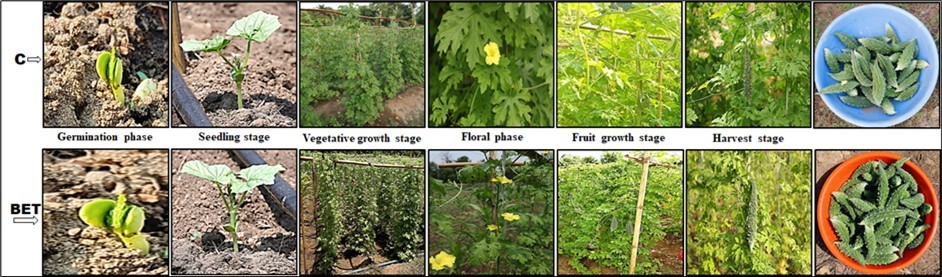
Download figure
Table 3 shows the qualitative traits of bitter gourd vegetative growth. The biofield energy-treated group (BTBIGG) had longer vines and stems than the control group (CONBIGG), which had medium-length. BTBIGG also had more primary branches, while CONBIGG had a medium number. Leaves were dark green in BTBIGG and medium green in CONBIGG, but both groups had five-lobed leaves with and yellow flowers. The fruit was dark green in BTBIGG and medium green in CONBIGG. Most fruits in both groups had continuous ridges and a spindle shape. Seeds were light brown in CONBIGG and brown in BTBIGG. Seediness was low (fewer than 10 seeds per fruit) in CONBIGG and medium (10–20 seeds per fruit) in BTBIGG.
Table 3. Effects of blessing (biofield/prayers) energy treatment (BET) on qualitative vegetative parameters of bitter gourd at 72 days after sowing (DAS).| Vegetative trait | Control group (CONBIGG) | Treatment Group (BTBIGG) |
| Cotyledon: intensity of green colour | Medium green | Green |
| Plant: main vine length | Medium (2.5-3.0 m) | Long (>3 m) |
| Stem shape | Angular | Angular |
| Stem length | Medium (5-8 cm) | Long (>8 cm) |
| Stem: number of primary branches | Medium (10 -15) | Many (>15) |
| Leaf blade shape | Cordate | Cordate |
| Leaf blade margin | Entire | Entire |
| Leaf blade colour (upper side) | Medium green | Dark green |
| Number of lobes in leaf blade | 5 lobes | 5 lobes |
| Flower colour | Yellow | Yellow |
| Colour of mature fruit (at harvesting) | Medium green | Dark green |
| Colour of mature fruit at ripening stage | Orange | Orange |
| Fruit shape (at maturity stage) | Spindle | Spindle |
| Fruit ridge | Continuous | Continuous |
| Seed colour (at the mature harvest stage) | Light brown | Brown |
| Seed surface | Smooth | Smooth |
| Seediness (number of seeds/ fruit) | Less (<10) | Medium (10-20) |
Crop Phenology and Yield Traits
The blessing energy-treated group had a higher germination rate (98.10 %) than the control group (CONBIGG, 84.28 %). Vine length was measured at 72 days after sowing and at harvest. At harvest, vine length in BTBIGG increased significantly (p ≤ 0.001) by 38.78 % compared to CONBIGG. The number of branches and nodes per vine in BTBIGG rose significantly (p ≤ 0.01) by 54.03 % and 32.34 %, respectively, compared to CONBIGG. Stem diameter and internodal length in BTBIGG increased significantly (p ≤ 0.001) by 13.37 % and 42.94 %, respectively compared to the CONBIGG. Leaf length and width in BTBIGG improved by 15.82 % and 15.90 %, respectively. The number of female flowers in BTBIGG increased by 30.80 % (p ≤ 0.05). Fruit weight, length, and width in BTBIGG increased significantly by 12.90 % (p ≤ 0.05), 33.27 % (p ≤ 0.001), and 30.68 % (p ≤ 0.001), respectively. Seed length, width, seed count per fruit, and 100 seed weight in BTBIGG increased significantly (p ≤ 0.001) by 40.32 %, 21.88 %, 52.50 %, and 33.27 %, respectively. The number of fruits per vine in BTBIGG increased significantly (p ≤ 0.001) by 66.88 %. Fruit yield per hectare was 61.31 % higher in BTBIGG compared to CONBIGG (Table 4).
Table 4. Quantitative assessment of phenology and yield traits of bitter gourd after treatment with spiritual blessing energy/biofield energy treatment (BET)| Quantitative Trait | Control Group (CONBIGG) | Treatment Group (BTBIGG) |
| Days to germination | 6-8 | 6-7 |
| Germination percentage (%) | 84.28 ± 0.19 | 98.10 ± 0.24*** |
| Plant vine length (m) | 2.94 ± 0.15 | 4.08 ± 0.18*** |
| Number of branches/vines | 15.27 ± 1.52 | 23.52 ± 1.63** |
| Number of nodes/vines | 48.77 ± 2.58 | 64.54 ± 2.17** |
| Internodal length (cm) | 5.17 ± 0.12 | 7.39 ± 0.15*** |
| Stem diameter (cm) | 1.87 ± 0.04 | 2.12 ± 0.02*** |
| Leaf length (cm) | 10.68 ± 0.24 | 12.37 ± 0.16*** |
| Leaf width (cm) | 8.74 ± 0.16 | 10.13 ± 0.08*** |
| Days to first male (staminate) flower appearance | 31.42 ± 1.63 | 29.35 ± 1.72 |
| Days to first female (pistillate) flower appearance | 37.48 ± 1.33 | 35.47 ± 1.14 |
| Days to 50% flowering | 55.22 ± 1.75 | 51.34 ± 1.37 |
| Number of male flowers | 152.44 ± 4.33 | 136.38 ± 6.17 |
| Number of female flowers | 35.72 ± 2.46 | 46.72 ± 2.37* |
| Days to fruit maturity | 61.62 ± 2.44 | 60.94 ± 2.21 |
| Fruit weight (gm) | 78.52 ± 2.83 | 88.65 ± 1.79* |
| Crop period (days) | 105.42 ± 3.48 | 105.72 ± 2.49 |
| Fruit length (cm) | 10.82 ± 0.39 | 14.42 ± 0.61*** |
| Fruit width (cm) | 5.77 ± 0.32 | 7.54 ± 0.16*** |
| 100-seed weight (gm) | 8.72 ± 0.08 | 11.62 ± 0.05*** |
| Seed length (cm) | 1.24 ± 0.02 | 1.86 ± 0.03*** |
| Seed width (cm) | 0.64 ± 0.02 | 0.78 ± 0.01*** |
| Seed count/fruit | 14.59 ± 0.26 | 22.25 ± 0.66*** |
| Number of fruits/vine | 9.36 ± 0.20 | 15.62 ± 0.14*** |
| Fruit yield (kg)/plant (vine) | 1.11 ± 0.11 | 1.63 ± 0.14* |
| Fruit yield (kg)/plot | 11.54 | 18.62 |
| Fruit yield/sq. m plot (kg/sq. m) | 1.03 | 1.66 |
| Fruit yield/hectare (ton/ha) | 10.26 | 16.55 |
Discussion
Bitter gourd is widely known not only as a food crop but also as a source of valuable chemical compounds that may help manage various disorders 27, 28. In this study, vine length, number of branches per vine, and leaf area showed significant differences at the 5% level of significance. BTBIGG seeds germinated quickly, likely because of their soft seed coat and strong ability to adapt to soil, while CONBIGG seeds germinated more slowly, possibly due to their harder seed coat 29. The experiment showed that bitter gourd can be grown successfully in India’s climate. The treated group had more primary branches per vine, which may be linked to longer vines and better photosynthetic ability in BTBIGG corroborated with the Liu et al. 2025 30. This could result from the slow release of soil nutrients and the supply of nitrogen as the plant grows. Since nitrogen is important for protein synthesis, it may have supported the growth of more branches in the treated BTBIGG group.
Reproductive parameters, such as the number of female flowers and fruits per plant, were significantly affected by treatments with organic formulations and growth regulators 31. In this study, these parameters also improved in the BTBIGG treatment group compared to the CONBIGG group, which did not receive any organic fertilizers or plant growth regulators, except for spiritual blessings energy/prayers/BET-Trivedi Effect® exposure to both seeds and land. Singh et al., 2025, found that using plant growth regulators resulted in bitter gourd yields of 1.57 to 1.62 kg per plant. In our study, without growth regulators, the BTBIGG group produced 1.63 kg per plant, which is similar to the results reported by Singh et al. (2015) 31 and is highly cost-effective. The higher fruit weight may be due to better nutrient absorption by the plants, possibly influenced by biofield energy transmission to soil nutrients, and to greater movement of photosynthates to the fruits during development and maturity 32. As fruit weight increases, so does the yield per plant. These results suggest that the blessing/BET-Trivedi Effect® can help maximize yield by improving fruit set, increasing the movement of assimilates, and strengthening the sink, leading to heavier fruits. Yield per plant is also linked to greater branches and node count. At maturity, both fruit length and weight were higher in the BTBIGG group than in the CONBIGG group. The variation in fruit weight in the treated group may be due to differences in vegetative growth, which affects photosynthesis and, in turn, fruit weight. This could be because of a higher accumulation of photosynthates in the fruits, leading to greater weight.
Conclusion
The study results suggest that the spiritual blessing/prayers/BET-Trivedi Effect® significantly improved morphological, phenological, and yield-related parameters of bitter gourd compared to the control group. Thus, blessing/BET-Trivedi Effect® could be a cost-effective approach for bitter gourd farming in the near future. This study can be used for high-quality bitter gourd production. Further studies are needed to understand the underlying mechanism of higher yields of bitter gourd.
Abbreviations
- NPK: nitrogen phosphorus potassium
- CAM: complementary and alternative medicine
- BET: biofield energy treatment
- CONBIGG: control bitter gourd group
- BTBIGG: biofield energy-treated bitter gourd group
- SSP: single super phosphate
- MOP: muriate of potash
- DAS: days after sowing
References
- 1.RVP Anunciado, Masangkay J S. (2002) Effects of bitter gourd (Momordica charantia L.) administration on alloxan-induced diabetic mice. Philips Journal of Veterinary Medicine 39(1), 15-20.
- 3.Krishnendu R, Nandini Putri. (2016) Nutritional composition of bitter gourd types (Momordica charantia L.). International Journal of Advanced Engineering Research and Science 3, 96-104.
- 4.Saeed F, Afzaal M, Niaz B, M U Arshad, Tufail T et al. (2018) Bitter melon (Momordica charantia): A natural healthy vegetable. International Journal of Food Properties 21(1), 1270-1290.
- 5.Jat G S, Behera T K, Singh A K, Bana R S, Singh D et al. (2024) Antioxidant activities, dietary nutrients, and yield potential of bitter gourd (Momordica charantia L.) lines in diverse growing environments. Front Nutr. 11, 1393476-10.
- 6.Singh R, Kumar A, Bhuvaneshwari K, K D Pandey. (2012) Gas Chromatography – Mass spectrometry analysis and phytochemical screening of methanolic fruit extract Momordica charantia. J. Rec. Adv. Agri 1(4), 122-127.
- 7.Bortolotti M, Mercatelli D, Polito L Momordica charantia. (2019) A nutraceutical approach for inflammatory related diseases. Front Pharmacol. 10-486.
- 8.Janagal B, Singh C, R P Purvia, Adlakha M. (2018) A review of hypoglycemic effect of Momordica charantia wsr to madhumeh. International Journal of Ayurveda and Pharma Research 6(1), 50-54.
- 9.Joshi A, Soni P, Malviya S, Kharia A. (2017) Memory enhancing activity ofMomordicacharantiaby scopolamine induced amnesia in rats. IP International Journal of Comprehensive and Advanced Pharmacology 2(1), 11-18.
- 10.L Y Bai, C F, P C Chu, W Y Lin, S J Chiu et al. (2016) A triterpenoid from wild bitter gourd inhibits breast cancer cells. Scientific Reports 6(1), 1-10.
- 11.Raman A, Lau C. (1996) Anti-diabetic properties and phytochemistry of Momordica charantia. 2(4), 349-62.
- 12.Trivedi M K, Branton A, Trivedi D, Mondal S, Jana S. (2023) Evaluate the safety and efficacy of a biofield energy treated proprietary dietary supplement (TRI 360™) on psychological symptoms, mental disorders, emotional well-being, and quality of life in adult subjects. Altern Ther Health Med 29(7), 104-113.
- 13.Trivedi M K, Branton A, Trivedi D, Nayak G, Gangwar M et al. (2015) Effect of biofield energy treatment on chlorophyll content, pathological study, and molecular analysis of cashew plant (Anacardium occidentale L.). J Plant Sci 3(6), 372-382.
- 14.Trivedi M K, Branton A, Trivedi D, Nayak G, Gangwar M et al. (2015) Evaluation of vegetative growth parameters in biofield treated bottle gourd (Lagenaria siceraria) and okra (Abelmoschus esculentus). Int J Nutr Food Sci 4(6), 688-694.
- 15.Trivedi M K, Branton A, Trivedi D, Nayak G, Gangwar M et al. (2015) Analysis of genetic diversity using simple sequence repeat (SSR) markers and growth regulator response in biofield treated cotton (Gossypium hirsutum L.). Am J Agric For 3(5), 216-221.
- 16.Trivedi M K, Branton A, Trivedi D, Nayak G, Mondal S C et al. (2015) Evaluation of plant growth regulator, immunity and DNA fingerprinting of biofield energy treated mustard seeds (Brassica juncea). Agric For Fish 4(6), 269-274.
- 17.Richer-de-Forges A C, Arrouays D, Chen S, Dobarco M R, Libohova Z et al. (2022) Hand-feel soil texture and particle-size distribution in central France. Relationships and implications. CATENA 213, 106155-10.
- 18.Walkley A, Black I A. (1934) An examination of Degtjareff method for determining soil organic matter and a proposed modification of the chromic acid titration method. Soil Sci 37(1), 29-38.
- 19.Menefee S G, Overman O R. (1940) A Semimicro-Kjeldahl method for the determination of total nitrogen in milk. J Dairy Sci 23(12), 1177-1185.
- 20.Bray R H, Kurtz L T. (1945) Determination of total organic and available forms of phosphorus in soils. Soil Sci 59(1), 39-46.
- 21.Shuman L M, Duncan R R. (1990) Soil exchangeable cations and aluminum measured by ammonium chloride, potassium chloride, and ammonium acetate. Commun Soil Sci Plant Anal 21(13), 1217-1228.
- 22.Chow T J. (1964) Flame photometric determination of potassium in sea water and marine organisms. Anal Chim Acta 31, 58-63.
- 23.Tucker B B, Kurtz L T. (1961) Calcium and magnesium determinations by EDTA titrations. Soil Sci Soc Am 25(1), 27-29.
- 24.Xu X, Luo Q, Zhang N, Wu Y, Wei Q et al. (2024) Sandy loam soil maintains better physicochemical parameters and more abundant beneficial microbiomes than clay soil in Stevia rebaudiana cultivation. PeerJ.
- 25.Silveira Maria. (2013) Soil acidity and its relationship with nutrient use efficiency. The Florida Cattleman and Livestock Journal. 1-4.
- 26.Farooqi Zia Ur Rahman, Qadir Abdul, Ayesha, Riaz Sobia, Chaudhary Zahoor et al. (2025) . Soil Acidification: Processes, Effects on Soil and Plants, and Remediation Strategies. Chapter: 6 Publisher: Academy of Sciences and Arts of the Republic of Srpska , Banja Luka .
- 27.Sharma S, M C Sharma, Kohli D. (2010) Wound healing activity of ether-chloroform extract of Momordica charantia fruits in rats. Digest J. Nanomat. Biostr 5(1), 123-126.
- 28.Malik Z A, Singh M, Sharma P L. (2011) Neuroprotective effect ofMomordicacharantiain global cerebral ischemia and reperfusion induced neuronal damage in diabetic mice. J Ethnopharmacol 133(2), 729-34.
- 29.Byregowda R, Nagarajappa N, Madhusudan K, T K Nagarathna, S A Kesaratagi. (2025) Probing the impact of seed coat removal on the germination performance of bitter gourd (Momordica charantia) using an image analyzer. Seeds 4, 3-10.
- 30.Z H Liu, M H Zhao, X Z Huang. (2025) Morphological characterization of high-yield bitter gourd populations under high-density planting and drip irrigation. Plant Gene and Trait 16(5), 234-241.