
Risk Factors and Control Strategies for Cattle Tick Infestations in Nigeria: Influence of Acaricide Application Methods, Hand-Picking Frequency, and Herd Mobility in Plateau State

Abstract
Background
Tick infestations severely impair cattle health and productivity in Nigeria through blood loss, hide damage, and transmission of tick-borne pathogens.
Objective
This study assessed key risk factors influencing tick infestation and evaluated control methods among Fulani pastoral herds in Plateau State.
Methods
A cross-sectional survey involving 250 cattle from ten herds was conducted across five Local Government Areas. Tick burden was analyzed against acaricide application methods (pour-on vs. hand-spray), hand-picking frequency, and herd mobility (sedentary vs. migratory). Data were collected via owner interviews and manual tick counts. Statistical analyses were performed using generalized linear models in R software.
Results
Cattle treated with pour-on acaricides had significantly lower tick burdens compared to those treated via hand-spray (P<0.05). Herds that practiced hand-picking five times weekly had fewer ticks than those hand-picking thrice weekly (P<0.01). Migratory herds recorded significantly lower infestations than sedentary herds (P<0.05).
Conclusion
Effective tick control requires the integration of optimized acaricide application, frequent manual removal and consideration of herd mobility patterns. Education, capacity building, and policy support are necessary to enhance adoption of effective tick control measures among pastoralists.
Article Information
- Received
- Accepted
- Published
Academic Editor: Andrei Alimov, Associate Professor Research Center for Medical Genetics, Moscow, Russia
Checked for plagiarism: Yes
Review by: Single-blind
Copyright © 2025 Biallah Markus Bukar, et al.
 This is an open-access article distributed under the terms of the Creative Commons Attribution License, which permits unrestricted use, distribution, and reproduction in any medium, provided the original author and source are credited.
Corresponding author: Goni Dogo Abraham, Department of Veterinary Parasitology and Entomology, University of Jos, Nigeria —
Competing Interests
The authors declare that they have no known competing financial interests or personal relationships that could have appeared to influence the work reported in this paper.
Funding
This research was funded by the Tertiary Education Trust Fund (TETFUND), Nigeria, through the National Research Fund (NRF) grant scheme. The funding covered field activities, laboratory analyses, and statistical processing.
Data Availability
No data-availability statement was provided by the authors.
Acknowledgements
The authors gratefully acknowledge the Africa Centre of Excellence in Phytomedicine Research and Development (ACEPRD), University of Jos, Nigeria, for providing the laboratory facilities, technical support, and logistical assistance necessary for the successful conduct of this research.
We also sincerely appreciate the Tertiary Education Trust Fund (TETFUND) through the National Research Fund (NRF) grant for their financial support, which was critical in funding this study. Without this support, the execution of the project would not have been possible.
Special thanks are extended to the Fulani pastoralists who participated in this study, and to all field assistants and staff members who contributed to data collection and sample processing.
Citation:
Introduction
Ticks are among the most economically significant ectoparasites affecting livestock globally, particularly in tropical and subtropical regions such as Nigeria. These arthropods inflict direct harm through blood feeding, skin damage, and irritation, while also serving as vectors for numerous pathogens including Babesia, Anaplasma, Theileria, and Ehrlichia species, responsible for devastating diseases such as babesiosis, anaplasmosis, theileriosis, and heartwater.
In Nigeria, the burden of cattle tick infestation is exacerbated by traditional livestock management systems dominated by Fulani pastoralists. Hand-picking of ticks remains a widely practiced method of control due to its simplicity and low cost. However, this method is labor-intensive, inconsistently applied, and largely ineffective against immature or cryptically located ticks. Meanwhile, chemical control strategies, particularly the application of acaricides, offer a more efficient alternative, although their effectiveness is contingent on proper usage and availability of quality products.
The movement patterns of cattle herds, particularly the distinction between sedentary and migratory systems, also play a crucial role in tick exposure dynamics. Migratory pastoralism, by disrupting stable environmental conditions needed for tick survival, may offer natural protection against heavy infestation.
Despite these insights, systematic evaluations of the comparative effectiveness of hand-picking, acaricide application methods, and herd mobility patterns under field conditions in Nigeria remain scarce. Understanding the relative contributions of these factors is critical for designing sustainable, integrated tick management strategies suited to the socio-economic realities of pastoral communities.
Therefore, this study aimed to assess the key risk factors influencing cattle tick infestation in Plateau State, Nigeria, focusing on acaricide application methods, frequency of manual hand-picking, and herd mobility. The findings provide evidence-based recommendations to enhance cattle health, optimize tick control strategies, and safeguard pastoral livelihoods.
Materials and Methods
Study Area
This study was conducted in Plateau State, North-Central Nigeria, between April and June 2023. Five Local Government Areas (LGAs)—Jos North, Jos South, Mangu, Pankshin, and Barkin Ladi—were purposively selected based on cattle density, ecological suitability for tick survival, and pastoral activity. The climate of the study area is characterized by a wet season (April–October) and a dry season (November–March), providing diverse conditions favorable for tick propagation.
Study Design and Herd Selection
A cross-sectional epidemiological survey design was employed. Ten Fulani pastoral herds (two per LGA) were selected using simple random sampling from accessible grazing communities. Herds were classified as either sedentary or migratory based on self-reported movement patterns over the preceding twelve months.
Data Collection
Questionnaire Survey
A semi-structured questionnaire, administered orally in the Hausa language, was used to gather data from herd owners or managers. The questionnaire collected information on:
· Method and frequency of acaricide application (pour-on vs. hand-spray)
· Manual tick removal (hand-picking) frequency per week
· Herd mobility classification (sedentary vs. migratory)
· Knowledge and awareness of tick-borne diseases
The questionnaire was pre-tested among non-participating pastoralists to ensure clarity and cultural appropriateness.
Tick Collection and Identification
From each herd, 25 cattle were randomly selected (n = 250). Adult ticks were manually removed using blunt-tipped forceps from predilection sites including the ears, dewlaps, flanks, tail base, udder, and scrotum. Collected ticks were preserved in 70% ethanol and transported to the laboratory at the Africa Centre of Excellence in Phytomedicine Research and Development (ACEPRD), University of Jos.
Tick species were identified morphologically using standard identification keys.
Tick Burden Estimation
For each animal, the total number of ticks collected was recorded as an individual tick burden score.
Statistical Analysis
All data were entered into Microsoft Excel 2019 and analyzed using R statistical software (version 4.3.2). Descriptive statistics were used to summarize categorical variables.
To assess associations between risk factors (acaricide method, hand-picking frequency, herd mobility) and tick burden, Generalized Linear Models (GLMs) with Poisson error distributions were fitted. Model significance was tested at a 95% confidence interval (P < 0.05). Where significant effects were observed, Tukey’s Honest Significant Difference (HSD) test was applied for post-hoc comparisons between groups.
Graphical representations were generated using the ggplot2 package in R.
Results
Risk Factors Influencing Cattle Tick Infestation
Impact of Acaricide Application Method
The method of acaricide application significantly influenced tick burden. Cattle treated with pour-on formulations had significantly lower mean tick counts (3.2 ± 0.5) compared to cattle treated via hand-spray methods (6.9 ± 1.1) (P < 0.05) (Table 1).
Table 1. Mean Tick Burden by Acaricide Application Method| Acaricide Application Method | Mean Tick Count ± SE | P-value |
|---|---|---|
| Pour-on | 3.2 ± 0.5 | < 0.05 |
| Hand-spray | 6.9 ± 1.1 |
Influence of Hand-Picking Frequency
The frequency of manual tick removal was significantly associated with tick infestation levels. Herds practicing hand-picking five times per week had lower mean tick burdens (3.6 ± 0.8) compared to those practicing it three times weekly (7.2 ± 1.3) (P < 0.01) (Table 2).
Table 2. Mean Tick Burden by Hand-Picking Frequency| Hand-Picking Frequency | Mean Tick Count ± SE | P-value |
|---|---|---|
| ≥ 5 times per week | 3.6 ± 0.8 | < 0.01 |
| ≤ 3 times per week | 7.2 ± 1.3 |
Influence of Herd Mobility
Herd mobility also significantly affected tick infestation levels. Migratory herds recorded a mean tick count of 3.9 ± 0.6, significantly lower than sedentary herds (6.7 ± 1.2) (P < 0.05) (Table 3).
Table 3. Mean Tick Burden by Herd Type| Herd Type | Mean Tick Count ± SE | P-value |
|---|---|---|
| Migratory | 3.9 ± 0.6 | < 0.05 |
| Sedentary | 6.7 ± 1.2 |
Graphical Analysis
Here’s a visual presentation of the key findings: Figure 1, Figure 2, Figure 3.
Figure 1. Mean Tick Burden by Acaricide Application Method.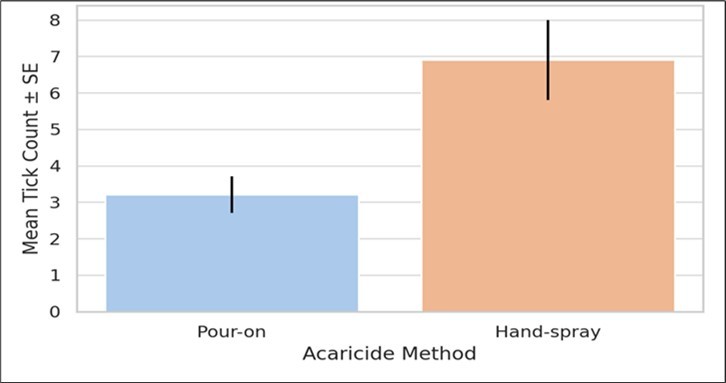
Download figure
Figure 2. Mean Tick Burden by Hand-Picking Frequency.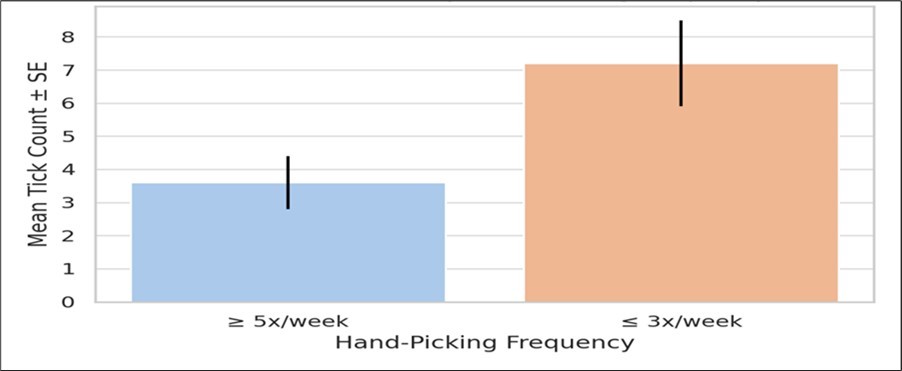
Download figure
Figure 3. Mean Tick Burden by Herd Mobility.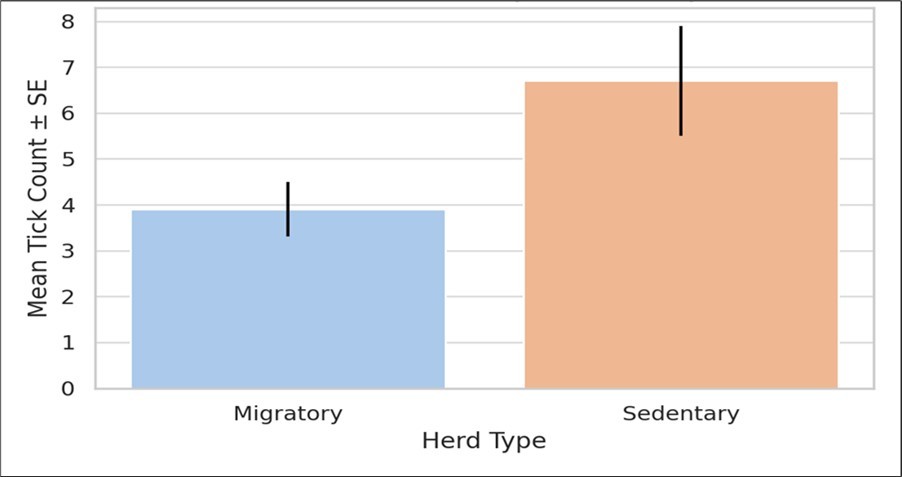
Download figure
Discussion
This study evaluated the influence of acaricide application methods, hand-picking frequency, and herd mobility on cattle tick infestation levels among Fulani pastoral herds in Plateau State, Nigeria. The findings provide valuable insights into optimizing tick control strategies in pastoral systems facing resource and infrastructure constraints.
The results demonstrate that the method of acaricide application significantly affects tick burden. Cattle treated with pour-on formulations exhibited significantly lower mean tick infestations compared to those treated with hand-sprays. This observation aligns with previous reports, suggesting that pour-on applications deliver better skin coverage, prolonged residual action, and ease of use, thereby enhancing tick control efficacy. In contrast, hand-spraying was associated with poor coverage and potential under-dosing, which could contribute to inadequate tick suppression and promote acaricide resistance.
Similarly, the frequency of manual tick removal emerged as a critical determinant of infestation levels. Herds practicing hand-picking five times weekly recorded significantly fewer ticks than those employing less frequent removal. Frequent hand-picking likely disrupts the tick life cycle by reducing opportunities for attachment, feeding, and reproduction. However, even frequent manual removal cannot completely prevent reinfestation, especially under high environmental tick pressure. Thus, hand-picking alone remains insufficient as a standalone control measure, particularly for immature or cryptically located ticks.
Herd mobility patterns also significantly influenced infestation levels. Migratory herds, which periodically moved across ecological zones, had lower mean tick counts compared to sedentary herds. Regular movement likely interrupts host-vector contact cycles, preventing the establishment of stable tick populations in specific grazing areas. These findings support earlier studies that identified nomadic pastoralism as a natural factor limiting ectoparasite buildup. In contrast, sedentary grazing practices facilitate tick survival and reproduction by maintaining consistent host availability within a localized environment.
Despite the demonstrated advantages of pour-on acaricides and frequent manual removal, several barriers hinder the widespread adoption of these practices among Fulani herders. Economic limitations, poor access to veterinary services, the high cost of quality acaricides, and the availability of counterfeit products remain major challenges. Cultural reliance on manual methods and limited awareness of the risks posed by tick-borne diseases further exacerbate the problem.
The integration of traditional practices with scientifically validated control methods appears critical for sustainable tick management. Educational outreach, provision of affordable, high-quality acaricides, and strengthening of veterinary extension services are essential steps toward improving cattle health and productivity in Nigeria’s pastoral systems.
One limitation of the study was the reliance on owner-reported herd mobility patterns, which may be subject to recall bias. Future research could incorporate GPS-based tracking to more precisely monitor cattle movements and exposure to tick-infested environments. Additionally, longitudinal studies assessing seasonal variations in tick infestation would provide a more comprehensive understanding of infestation dynamics.
Conclusion
This study identified acaricide application method, hand-picking frequency, and herd mobility as significant risk factors influencing cattle tick infestations among Fulani-managed herds in Plateau State, Nigeria.
Pour-on acaricide formulations were significantly more effective than hand-spray methods in reducing tick burden, highlighting the importance of proper chemical application techniques. Increased frequency of manual tick removal—specifically hand-picking five times per week—was also associated with lower infestation levels, although manual methods alone were insufficient for complete control. Additionally, migratory herds demonstrated lower tick burdens compared to sedentary herds, suggesting that pastoral mobility serves as a natural interruption to host-vector dynamics.
Effective tick management in pastoral systems should adopt an integrated approach combining frequent manual removal, strategic acaricide use, and recognition of the protective effects of herd mobility. Strengthening veterinary extension services, promoting education on acaricide application practices, and enhancing access to affordable, high-quality chemical products are critical for improving tick control among Fulani pastoralists.
By optimizing existing practices and encouraging evidence-based interventions, cattle health, productivity, and pastoral livelihoods in Nigeria can be significantly enhanced, contributing to broader goals of food security and economic development.
Author Contributions
· Goni Dogo Abraham: Principal Investigator, Conceptualization, Supervision, Writing – Review & Editing
· Uchechukwu C. Ohaeri: Data Analysis, Visualization, Writing – Review & Editing
· Henry Madubuike: Statistical Support, Validation, Methodology
· Gloria Karaye: Investigation, Resources, Data collection supervision
· Mark Kparmark: Data Curation, Field Coordination
· Davwet Benkaat Maxwell: Investigation, Data Collection, Writing – Original Draft Preparation
Ethical Approval Statement
This study was conducted in accordance with institutional ethical guidelines. Ethical approval was obtained from the Animal Ethics Committee of the University of Jos, Nigeria (Protocol ID: UJ-AEC/2023/04). Prior informed verbal consent was obtained from all participating cattle owners and herders before questionnaire administration and sample collection.
All procedures involving animals were carried out in compliance with international best practices for animal welfare and under the supervision of qualified personnel.
References
- 1.George J E, Pound J M, Davey R B. (2004) Chemical control of ticks on cattle and the resistance of these parasites to acaricides. Parasitology. 129-353.
- 2.Mamman A H, Lorusso V, Adam B M, Dogo A G, Bown K J et al. (2021) First report of Theileria annulata in Nigeria: Findings from cattle ticks in Zamfara and Sokoto States. Parasites Vectors. 14-2.
- 3.Rajput Z I, Hu S H, Chen W J, Arijo A G, Xiao C W. (2006) Importance of ticks and their chemical and immunological control in livestock. J Zhejiang Univ Sci 7(11), 912-21.
- 4.Walker A R. (2014) Ticks of Domestic Animals in Africa: A Guide to Identification of Species. Edinburgh: Bioscience Reports;.
- 5.Gonsu S, Yesil M, Yilmaz N. (2019) Cattle grooming behavior and challenges with technological grooming tools. J Environ Sci Eng 8.
- 6.Samdup T, HMJ Udo, Eilers C H, MNM Ibrahim, AJ van der Zijpp. (2010) Crossbreeding and intensification of smallholder crop-cattle systems in Bhutan. Livest Sci. 132-126.
- 7.Kaiser M N, Sutherst R W, Bourne A S. (2002) Development of a comprehensive strategy for the control of Amblyomma variegatum in Africa. Trop Anim Health Prod. 34, 77-95.
- 8.Estrada-Peña A, Bouattour A, Camicas J L, Guglielmone A, Horak I et al. (2006) Distribution and ecological preferences of Boophilus ticks in Africa and Latin America. Exp Appl Acarol. 38, 219-35.
- 9.Pfäffle M, Littwin N, Muders S V, Petney T N. (2013) The ecology of tick-borne diseases. Int 43(12), 1059-77.
- 10.Minjauw B, McLeod A. (2020) Tick-borne diseases and poverty: The impact on livelihoods. in Africa. FAO; 2003. [Accessed 16 Available from: http://agris.fao.org/agris-search/search.do?recordID=GB2012100456 .
- 11.Obadiah H I, Shekaro A. (2012) Survey of tick infestation on cattle in Zaria Abattoir. , Nigeria, J Vet Adv 2-2.
- 12.Atsuwe T S, Azua E T, Obisike V U, Imandeh G N. (2019) Comparative study on tick-borne haemoparasites in cattle and goats in. , Makurdi, Nigeria, J Appl Life Sci Int 19(4), 1-6.
- 13.Maina J A. (1987) Animal health in subhumid Nigeria. Proceedings of the Second ILCA/NAPRI Symposium , Kaduna, Nigeria .